Editor
Date
Overview
There is a pattern I encounter constantly in conversations with clients, friends, and people who reach out online. They have tried to change something — a reaction, a habit, a way of thinking — multiple times. They have read the books, done the journaling, maybe tried therapy. Things improve for a while. Then they return to baseline.
What is one pattern in your life that you have tried to change more than three times? And what was the approach each time?
If the approach was try harder, be more disciplined, or understand why I do this — the science suggests why it did not hold. Not because you are not capable of change. Because those approaches do not reach the level where change actually happens.
Neuroplasticity is real. The brain genuinely can change throughout adulthood. But there is a mechanism to it — three specific ingredients — and without all three, the attempt either does not create new pathways or does not make them strong enough to compete with the old ones. This post explains the mechanism precisely. Because "the brain can change" is not useful on its own. Understanding how to make it change is what actually matters.
The Short Answer
Neuroplasticity is the brain's ability to form new neural connections throughout life — a structural, physical process, not a metaphor. But it does not happen through positive thinking or good intentions alone. It requires three things in combination: novelty (a genuinely new experience or pattern), elevated emotion (emotional engagement that signals the brain to encode the experience), and repetition (enough rehearsal for the new pathway to become the default). Most self-improvement attempts miss at least one of these — which is why the change does not hold.
What Neuroplasticity Actually Is — and What It Isn't
The brain contains approximately 86 billion neurons, each forming thousands of connections with others. Every thought you think, every experience you have, every emotion you feel corresponds to a specific pattern of neurons firing together. The more a pattern fires, the more efficient it becomes — the connection strengthens, the pathway myelinates, the response becomes faster and more automatic.
This is Hebb's Law, first described by neuropsychologist Donald Hebb in 1949: "neurons that fire together, wire together." The inverse is equally important: connections that are not used weaken and eventually prune away. The brain is continuously self-optimising — keeping what is used, releasing what is not.
Nobel Prize Laureate Eric Kandel demonstrated this structurally: if you learn one piece of information and review it for one hour, the number of neural connections doubles. But if that information is not repeated, those connections prune away within hours or days. The NCS framework I work with states this directly: "information is not just in the brain; now it's in the body." Patterns that have been repeated long enough are stored not just neurologically but physiologically — in the autonomic nervous system, in the body's habitual tension, in its chemical defaults.
This is why neuroplasticity is not just an optimistic idea. It is a structural description of how the brain actually works. The question is not whether your brain can change. It is what conditions are required for that change to be durable rather than temporary.
The Three Ingredients for Real Neuroplastic Change
1. Novelty
The brain allocates neuroplastic resources to new experiences — situations, behaviours, and patterns of thought that are genuinely different from what has come before. Old habits fire the same neural pathways. They deepen those pathways, but they do not create new ones. The NCS framework is precise on this: "the same thoughts lead to the same choices, the same choices to the same actions, the same actions to the same experiences, the same experiences to the same feelings." The loop is self-sealing. To exit it, something genuinely new has to be introduced — not a slightly better version of the same pattern, but an interruption of it.
This is why insight alone — understanding why you behave a certain way — rarely produces durable change. The understanding is processed by the analytical mind. But the pattern is stored in the body, in the cerebellum, in the autonomic nervous system. Knowing about it does not interrupt it. A new experience does.
2. Elevated Emotion
The amygdala — the brain's emotional processing centre — tags experiences for encoding. High-emotion experiences are flagged as important and encoded more deeply in the hippocampus, where long-term memory consolidates. This is why traumatic experiences are remembered in vivid detail decades later, and why something that happened while you were emotionally flat is gone by the following week.
The same principle applies to positive change. New patterns formed under conditions of genuine elevated emotion — curiosity, meaning, enthusiasm, gratitude — encode more deeply than those formed from obligation or willpower. This is the mechanism behind the NCS teaching that combining a clear intention with an elevated emotion creates the neurological conditions for genuine state change. The emotion is not motivational decoration. It is the signal that tells the brain: this is worth wiring in.
Affirmations fail here when they are verbal without visceral. Reading "I am confident" while feeling anxious sends a mixed signal. The body's felt experience, not the words, is what the nervous system encodes. This is not a problem with the concept — it is a sequencing error. The emotion has to be genuinely present, not just intended.
3. Repetition — But the Right Kind
New neural pathways need reinforcement to become defaults. But repetition without novelty or emotion does not create new pathways — it deepens existing ones. This is the paradox that traps most behaviour change attempts: doing the same thing more consistently does not generate the neurological change required for it to become natural. Humans think between 60,000 and 70,000 thoughts per day, and approximately 90% of those thoughts are identical to the day before. Consistent repetition of the same patterns, however disciplined, does not constitute neuroplastic change.
What repetition provides, when combined with novelty and emotion, is consolidation — the gradual process by which a new pathway becomes the path of least resistance. The NCS research framework describes this as moving from a new idea to a new experience to a new feeling — and when that cycle repeats enough times, the new pattern becomes part of the personality itself: how you think, how you act, how you feel.
Why Most Rewiring Attempts Don't Hold
Cortisol actively suppresses hippocampal neurogenesis — the production of new neurons in the area responsible for learning and new memory formation. Attempting to install new patterns while in a chronic stress state is neurologically self-defeating. The brain cannot build what stress is simultaneously dismantling.
Beyond the cortisol problem, there are two structural reasons most rewiring attempts fail.
First: working at the level of behaviour rather than identity. The NCS framework defines personality as how you think, how you act, and how you feel — the full state of being. Behaviour change without identity change is always temporary, because the old identity continues generating the old behaviours. When the changed behaviour conflicts with the self-concept — "someone like me doesn't do this" — the brain treats the new pattern as foreign and gradually corrects toward the familiar. The identity is the operating system. The behaviour is an application running on top of it.
Second: working against the nervous system rather than with it. A nervous system running in a chronic activation state — high cortisol, high-beta brain waves, survival mode — is not in the neurological condition for new learning. The prefrontal cortex, which governs intentional new behaviour, is suppressed. The basal ganglia, which runs the old automatic patterns, takes over. Trying to install a new pattern in this state is not just difficult — it is working against the biological priority system of the brain.
"In order to change, you must think greater than how you feel — greater than your environment, your body, and time. You must be greater than the habit of being yourself."
— Dr. Joe Dispenza — NCS Framework
What Actually Works: Three Evidence-Based Approaches
Regulate First
Before attempting any new pattern, create the neurological conditions for new learning. This means getting the nervous system out of activation before beginning — through slow breathing (extended exhales activate the vagus nerve and downregulate cortisol), deliberate movement, or simply pausing long enough to shift from reactive to reflective mode. The NCS framework's breathe practice — slow inhale to 5 counts, hold, exhale to 5 counts, set an intention — is precisely this: not relaxation for its own sake, but preparation of the neurological substrate for what follows.
Combine Novelty with Elevated Emotion
New experiences, approached with genuine positive emotional engagement, are the strongest driver of neuroplastic change. This does not require dramatic life changes. It can be as simple as approaching a familiar situation with deliberate curiosity — asking a different question, choosing a different response, or practising a new thought pattern while in a state of genuine interest or appreciation.
Visualisation, done correctly, works precisely here. The Piano Player Experiment established that mental rehearsal activates the same neural pathways as physical practice — the brain does not meaningfully distinguish between a vividly imagined experience and a real one. When visualisation is practised in a regulated, emotionally elevated state, it installs new circuitry before the new behaviour even begins. This is the mechanism behind the NCS certification work I do through Dr. Joe Dispenza — combining regulated states with elevated emotion and intentional new experiences. It is not motivational. It is neurological.
Shift the Identity, Not Just the Behaviour
Language matters here — not because words are magic, but because the frontal lobe responds to conscious, repeated self-definition. "I am trying to..." frames the behaviour as external and effortful. "I am someone who..." frames it as identity — something the brain is wired to protect and reinforce. The NCS framework's question — "who do I want to become?" — is the entry point into identity-level change. What would that person think? How would they act? What would they feel? When the answers to those questions become the daily rehearsal, the new pattern has a stable platform to consolidate on.
"When you change your personality, you change your personal reality. Your future is no longer your past."
— Dr. Joe Dispenza — NCS Framework
The Daily System: Why 15 Minutes a Morning Changes Your Brain
Theory without practice does not create neuroplastic change. Understanding the mechanism is the first step. The second step is a repeatable daily structure that applies all three ingredients — regulated state, novelty, and elevated emotion — consistently enough for new pathways to consolidate.
The system I have developed with clients is built on a single foundational principle from the NCS research: your personality — how you think, how you act, and how you feel — creates your personal reality. Change the personality, and the reality changes with it. The system is designed to make that shift concrete, daily, and cumulative.
What makes it powerful is also what makes it unusual: it begins with awareness of the old self, not with motivation to be the new one. Most morning routines start with optimism. This one starts with metacognition — the scientific term for becoming conscious of your unconscious patterns. You cannot change what you cannot see. The system creates that visibility first, then redirects deliberately.
Here is the structure — four questions, 15 minutes, every morning. The questions are simple. Their cumulative effect, practised daily over weeks and months, is measurable neuroplastic change — not as a metaphor, but as a structural shift in which thoughts and feelings your brain treats as its default state.
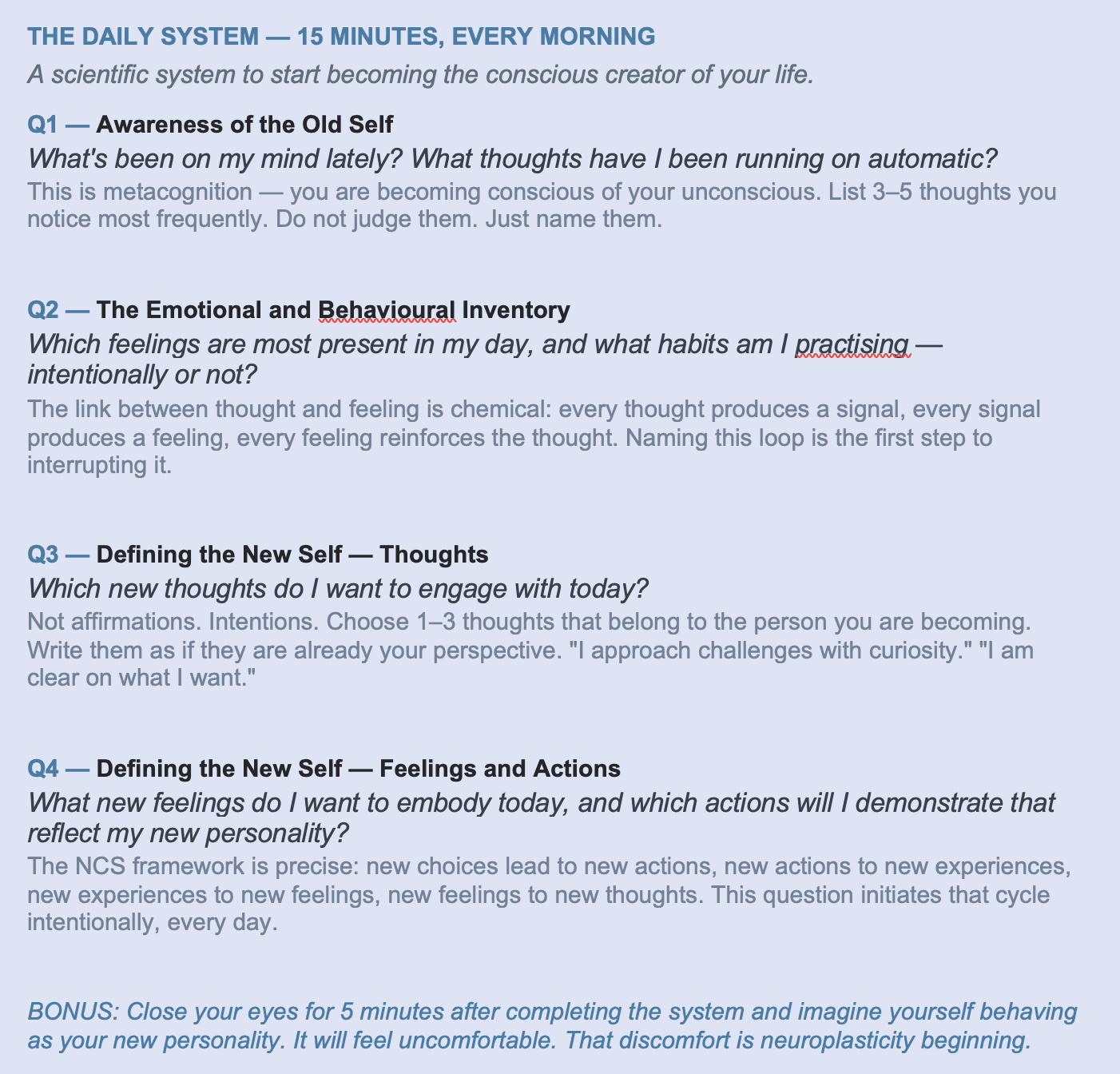
The system works because it addresses all three neuroplastic ingredients simultaneously. The regulation moment is built in through the deliberate slowing required to answer honestly. The novelty is the daily practice of choosing new thoughts and feelings — genuinely new, not habitual. The repetition is the daily structure itself, compounding over time into a new default state.
Dr. Joe Dispenza puts the underlying principle directly: "Nothing changes in your life until you change." The Daily System is the practical mechanism through which that change is made neurologically real — not through willpower, but through consistent, structured rehearsal of a new way of being.